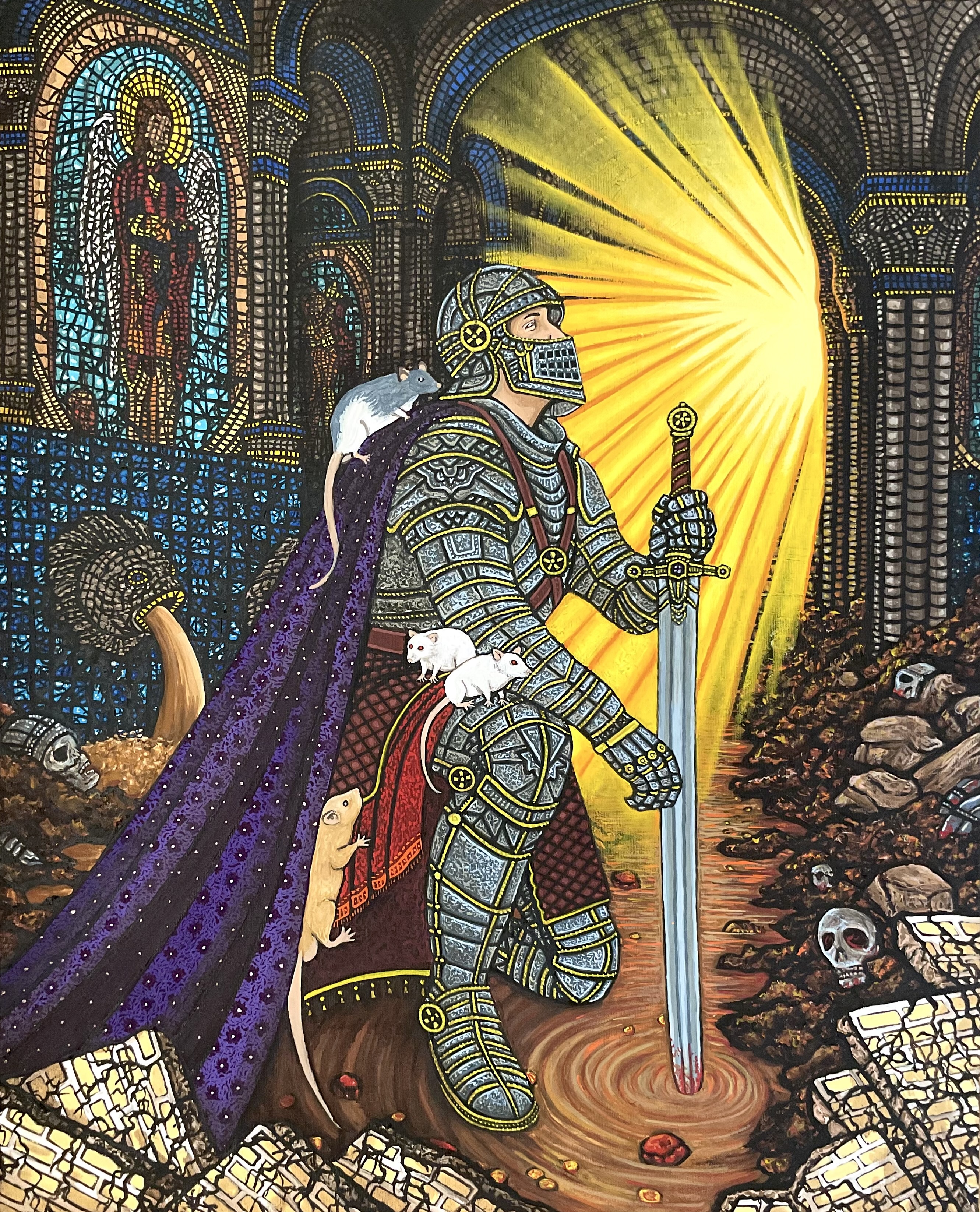
The painting opens a new cycle titled Violet, which began in 2026 as a continuation of the previous series Amaryllis. While Amaryllis was primarily built around individual moments of self-portraiture, Violet is conceived as a continuous narrative in which each painting represents a subsequent chapter. The central figure is the artist’s self-portrait alter ego - a knight who, following his previous experiences, enters a new space wearing heavy armor. The armor represents protection from the outside world, disappointment, pain, and failure, while at the same time embodying its own weight and burden. The figure does not lean on the sword as a weapon, but rather as a source of support. Carried on the armor and cloak are the artist’s beloved pet rats, representing home, safety, and relationships that a person carries with them even when everything else becomes uncertain.
The scene takes place in a space reminiscent of a Christian catacomb, referencing the origins of European Christian art while simultaneously functioning as a metaphor for the underground, shelter, and rebirth. The catacomb is a place where faith, death, and the emergence of a new visual language intersect. On the left side stands a stone gargoyle, from whose mouth water and waste flow into the space. It functions as a symbolic intermediary between the world above and the underground realm in which the story unfolds. Everything that comes from the outside world is carried into the catacomb as waste - everything society does not want to see, yet is simultaneously unable to get rid of. The gargoyle therefore represents a mechanism through which dark and unwanted things are merely pushed beneath the surface.
Among the ruins surrounding the figure lie dead bodies and bones, representing everything that had to end, disappear, or be overcome in order for a new story to begin - past versions of the self, failures, disappointments, and experiences that can no longer be brought back to life. The sewer, corpses, and gargoyle therefore form an image of accumulated past experience which remains present, yet gradually loses its power.
Among the ruins lie money and gemstones, whose meaning is intentionally ambivalent. They refer to the amount of work, exhibitions, and apparent professional success that may nevertheless fail to provide a corresponding sense of fulfillment. Although the artist participated in twelve exhibitions over the previous year, what remains most strongly is a feeling of exhaustion and disillusionment. The valuables therefore do not appear as trophies held by a victor, but lie seemingly worthless on the ground among waste and dead bodies. They become a critique of the art world, in which the value of artistic creation can easily be reduced to money, marketability, and the number of exhibitions, and in which an artist may be perceived more as a means of generating profit than as a human being and creator.
The painting thus questions the true cost of success when it is paid for with one’s own energy, psychological strength, and sense of meaning. Opposing this current of the past is an intense light emerging from the east on the right side of the composition. It does not represent victory or immediate liberation - the figure is still standing among the ruins. It is, however, the first indication of a direction in which it may be possible to continue. The composition therefore creates a movement from left to right: on the left comes waste and the past; at the center stands the figure, burdened by his armor; and from the right comes light as a possibility of the future.
The violet cloak becomes the visual symbol of the entire Violet exhibition, combining protection, spirituality, melancholy, and transformation. In the lower corners appear broken fragments of a wall covered with white and yellow tiles, directly continuing the visual motif of the final self-portrait from the Amaryllis series, painted in 2025. The wall that enclosed the previous story has now been broken apart, and its fragments lie within the new space. The past has therefore not disappeared - it has been breached and has become part of the next journey.
The entire painting represents a moment between two worlds: the old story has ended, but the new one has not yet been written. The figure simply stands at its threshold, carrying with him what he loves, leaning on the last remaining point of support, and turning toward the light for the first time.
Information concernant l’œuvre artistique
Peinture - HuileTaille de l'oeuvre - P 65 | L 80 | H 3
Crée le 1 juillet 2026